

Henry I of England, King from 1100 to 1135, towards the end of his reign, had notoriously at least 20 illegitimate offspring, and found himself in a predicament related to the succession. His marriage had been unfortunately less fruitful. His first wife, the pious Anglo-Saxon princess Edith Matilda, produced only two babies before she “ceased to either have offspring or desire them”. And his second, the much younger Adeliza of Louvain, failed to produce a replacement for his heir presumptive, William who drowned in the White Ship disaster of 1120. Consequently, Henry’s only legitimate child was a daughter Matilda, who in 1127 was formally recognised as his heir.
Born in 1102, Empress Matilda combined the blood of two dynasties: the House of Wessex and their conquerors the dukes of Normandy. As a widowed German empress she was named heir successor by her father, Henry I. Given that the entire Anglo-Norman nobility swore to support her claim to the throne, this should have guaranteed her peaceful accession as England’s first queen regnant. Matilda at the age of seven sent to Trier to learn the language and customs of his people, at 12 she was married to this man who was two decades later her senior. He schooled her in the art of government and trusted her to serve as regent in his absence, but left her a widow at 23 when he died in 1125. Matilda returned home, taking with her imperial treasures including the Hand of St James- which future emperors spent several years trying unsuccessfully to retrieve from its new home at Reading Abbey. Soon her father found her a new husband Godfrey of Anjou, a count a decade her junior, who was such a pessimist that he had the motto “Bad today but worse tomorrow” carved above the gates of one of his castles. Their marriage was supposed to cement peace between England and Normandy and Anjou. Understandably the former empress was initially unimpressed by this unequal match. But after his death in 1135, supposedly from eating too many lampreys, the couple living on the French side of the Channek, had formed a effective partnership, which allowed them to respond forcefully when, within a month, Matilda’s place on the English throne was usurped by her cousin, Stephen of Blois, who crowned himself King of England. Civil war followed, and she ruled the south-west of England in opposition.
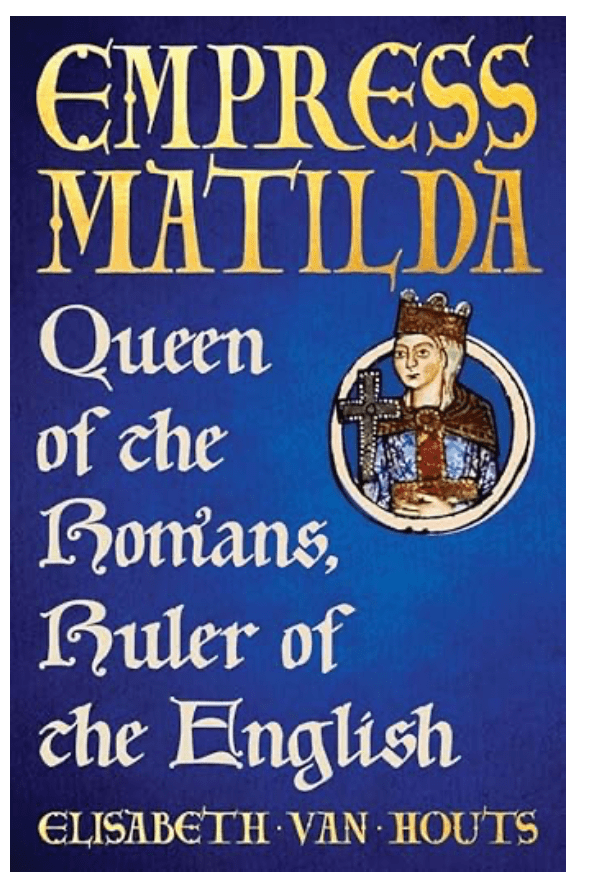
Elisabeth van Houts, professor of medieval European history at Cambridge Univeristy, explores the remarkable life of medieval England’s only queen regnant, and examines the female rulership in the Middle Ages, from Matilda’s relationships with her husbands, to her self-identification as granddaughter of William the Conqueror. Matilda used her persuasiveness effectively with the men who surrounded her, including her father, husbands, half-brothers and cousins.
In the 12th century even a potential queen could be a shadowy figure, and Van Houts is sometimes forced to flesh out her rigorous analysis of chornicles and charters with highly informed speculation about Matilda’s feelings. But it is clear that Matilda was justifiably furious about this turn of events. Starting in Normandy, she took an active role in the campaign to secure her inheritance. Two months after giving birth to their third son, she led an army into the duchy to rescue a wounded Godfrey, who was described by one contemporary chronicler as “his wife’s stipendiary commander”. And in 1139 it was Matilda supported by one of her half-brothers Robert, the first Earl of Gloucester who invaded England. Two years later, having captured Stephen, she came close to achieving her ambitions, ruling the country as “Female Lord of the English”. For several months in 1141 she enjoyed all the powers of a monarch, issuing coins, meeting her advisers and appointing loyal men to earldoms and bishoptics.
Then quite abruptly, it all went wrong. London rebelled just a s Matilda was preparing to be crowned and she was forced into a devastating retreat; by the end of the year Stephen was back on the throne. Although Matilda remained in England for several more years, southwest, she never regained the upper hand. After her flight from Oxford across a frozen river she rarely left her base at Devizes Castle.
Empress Matilda: Queen of the Romans, Ruler of the English by Elisabeth Van Houts, Yale University Press, $40, 464 pages.

