

The twentieth century is understood as an era of growing, inexorable secularism, yet in Britain between the 1890s and the 1960s there was a marked turn to Rome. In the first half of the century, Catholicism attracted more than half a million converts among them fascinating artists, writers and thinkers, after it became an intellectual and spiritual fashion. These men and women joined the church, and what difference did conversion make to them?
Henry Scobie a Catholic policeman in wartime Sierra Leone finds himself mathematical blind, as it would be a mortal sin for him not to go to Mass with his wife, Louise, but if he does not take Communion when they go, she will suspect that he has been having sex with a young widow. Although he tries the confessional beforehand, he cannot receive absolution because he refuses to obey Father Rank’s instruction to steer clear of Helen Rolt. If he takes Communion in his state of mortal sin, then he will damn himself, but he goes ahead anyway and receives “the pale papery taste of an eternal sentence on the tongue”. Christ soon reproaches him, speaking from the wafer lodged in his gullet. Scobie then compounds is perdition, killing himself with sleeping pills. By committing the greatest and most irredeemable of sins, he hopes to trade his damnation for Louise and Helen’s peace, an act almost holy in its perversity.
George Orwell accused Graham Greene about his book Heart of the Matter (1948), of being a spiritual snob, who had turned Hell into “a sort of high-class night club, entry to which is reserved for Catholics only”. Evelyn Waugh called Scobie’s spiritual deal a “mad Blasphemy, for God whoaccepted that sacrifice could be neither just nor lovable”.
By the time Westminster Cathedral was consecrated in 1910, Irish immigration rather than conversion explained the rise in the Catholic population of England and Wales to around 1.7 million. Half a million or so conversions between 1910 and 1960 sounds impressive, but the yearly rate never exceeded sixteen thousand – always greatly fewer than the cradle Catholics lost to “wastage”. Conversion was them, as it still is, generally a romantic rather than an intellectual phenomenon in which people- Greene among them- adopted the faith of Catholics they married.
Converts interpreted Rome to England all the same. The most gifted priests were often converts themselves and couched Roman Doctrines in sophisticated ways quite different from the rude assertions of the Penny Catechism. Converts often claimed that they had little prior acquaintance with Catholic worship, which seemed less dignified than the Prayer Book services of their youth. The Anglo-Catholic movement in the Church of England allowed the curious to try on Roman outfits or even to pose as monks without submitting to the pope- the inmates of an Anglican monastery on the New Kent Road swapped cassocks for suits to commute to jobs in the city. McDonagh, who had trad leanings, prefers to believe that revived use of the Latin Mass might explain today’s modest uptick in conversations. Catholic journalists like McDonagh, wants to investigate the way converts change the religion they embrace. Before Palm Sunday this year, the New York Times found American bishops buzzing over a surge in new arrivals. America’s Catholics, their aggressive confidence and traditionalism stand out. J.D. Vance , the vice president of the United States converted only seven years ago, lectures Pope Leo on theology and has just published his spiritual autobiography.
Frederick Rolfe, who was from a family of Dissenting piano-makers and had developed a fascination with the Borgia popes, had been too strange for his classmates to handle. He became a minor contributor to the Yellow Book, he never gave up on the priesthood- hence the deliberately misleading “Fr Rolfe” of his title pages. His novel Hadrian the Seventh (1904) narrates with solemn dream logic the impasse in the conclave that forces the cardinals to choose as pope George Rose, an expelled Seminarian turned scribbler. As Pope Hadrian, he strives for the conversion of England and summons Europe’s crowned heads to avert a world war, before a socialist stabs him, to death as he strolls around Rome. One hopes that for every J.D. Vance, we have a Fr Rolfe in store.
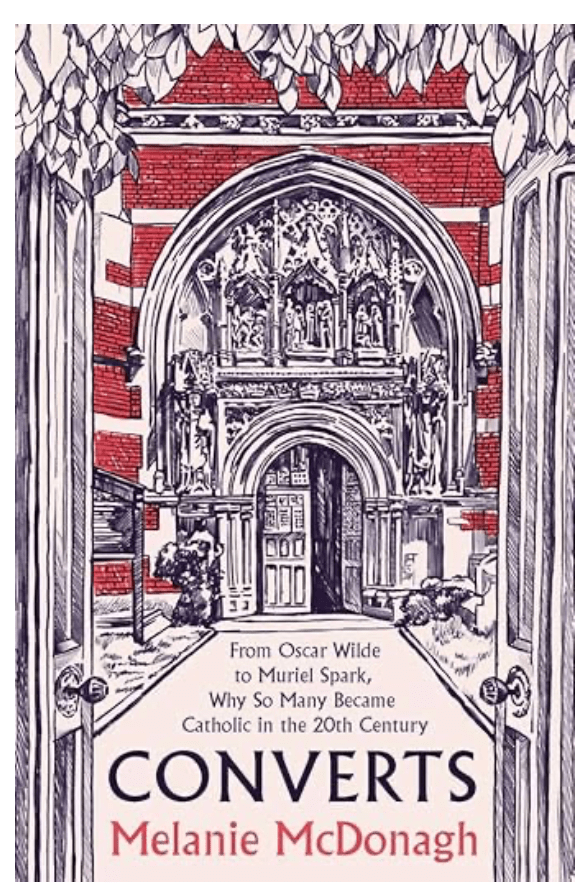
Converts: From Oscar Wilde to Muriel Spark, Why So Many Became Catholic in the 20th Century by Melanie McDonagh, Yale, £12.99, 384 pages.

