

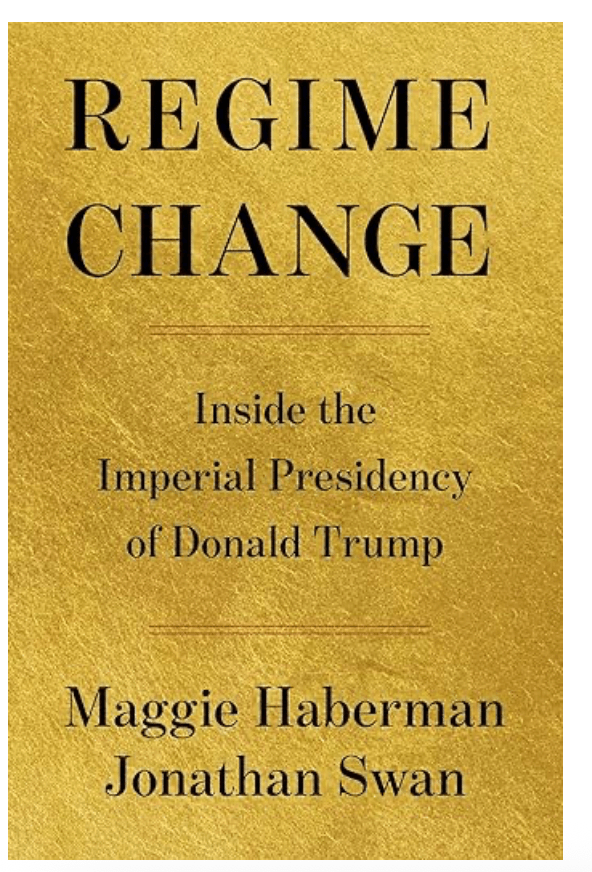
A typical day in Donald Trump’s White House. He awakes at 10am having been up most of the night posting on True Social and the fact that his bedroom has two large TV screens. His bathroom, has one too, Melina sleeps in a separate bedroom, keeping better hours. The schedule for the day printed by Trump’s chief of staff Susie Wiles ( whom Trump has nicknamed as “the Ice Maiden”. Aides wonder in and out of the Oval Office as one meeting jumbles into another. A CEO might be on the couch next to a Republican Senator or a foreign leader. Amid all these Trump might add a cell phone call from a business pal or a reporter. Often someone refills his Diet Coke. Trump’s second term has become “almost entirely housebound”, White House correspondents for the New York Times, Maggie Haberman and Jonathan Swan writes. Disturbing but illuminating reportage with vivid details that makes these events feel actual by wresting reality itself back from the distorted world of entertainment, illusion, fantasy and denial that Trump has generated around himself, It is this flood of provocation, atrocity, self-dealing and fabrication that makes Maggie Haberman and Jonathan Swan’s counter narrative so viral. A riveting, intimate, and revelatory account of the most radical and consequential presidency of our time. From the two reporters who have covered him more closely than perhaps anyone else over the past decade comes this definitive portrait of Donald Trump in the White House. Regime Change covers the first year of Trump’s second presidency – a term liberated from every constraint that defined his first. The generals who once told him “no” are gone, and the lawyers who remain have learned to pick their battles. His administration has flouted court orders and he has claimed powers that Congress once checked. What remains a President willing to take enormous risks that have upended global markets and topple heads of state, an imperial president operating almost entirely on instinct alone.
Howard Lutnick, Trump’s secretary of commerce, because he donate $25 million to the planned Trump library in Florida, are there mostly because they are rich. According Hauberman and Swan, the sessions on the opinion polls and political chit-chat that pre-occupied Trump in his first term are increasingly rare. “It is pure Trump now” as Steve Bannon, Trump’s former chief strategist, said. His dominance in the air-waves Trump is different, now. When he departed Andrews Airbase in January 2021, no significant Republican figure was there to wave him off. The disgrace of the January 6 storming of Capitol Hill two weeks earlier on the back of his claim of a stolen election had made a pariah of the departing president. He got back to the White House having turned belief in that whopping lie into a loyalty test. He is now surrounded by only loyalists, many picked because they look like they are from “Central Casting”. Scott Bessent Trump’s Treasury secretary and Peter Hegseth, trash-talking secretary of war and former TV anchor. Hegseth shows Trump videos of US missile strikes or boats being vaporised in the Caribbean. The book’s account of Israeli leader Benjamin Netanyahu’s role in convincing Trump to attack Iran in February is truly astonishing. Trump’s epic call to Netanyahu a few weeks earlier after Israeli jets had struck Hamas buildings in Doha, Trump said “Everybody is sick of you” with two of his negotiators Jared Kushner and Steve Witkoff “Even the Two Jews on this call are sick of you”, which set off a frantic push to cajole Netanyahu into making a public apology to Qatar.
Based on hundreds of interviews and unprecedented reporting from deep within the administrations most closely guarded rooms, Regime Change takes the reader inside the Situation room and in to the Secret Oval Office deliberations that have launched a new war in the Middle East and seen Trump troops into cities, and send immigration agents into deadly clashes with protectors. Maggie Haberman and Jonathan Swan bring us behind the scenes of a presidency that has transformed the culture, turned the Justice Department into an agent of retribution against the President’s enemies and the office itself into a brazen vehicle for profit. They also reveal a second term propelled by a historical irony that Trump himself has come to understand: that the indictments, the convictions, the assassination attempts, and four years of exile made him not weaker but far more powerful, more vengeful and more willing to gamble that any president in modern history.
This is the story of how Trump has used that power, who has tried to stop him, and why nearly all of them have failed. It is also the story of something American journalists are more accustomed to chronicling in distant capitals than in their own: a President who has fundamentally altered the nature of the office he holds- and, with it, how the rest of the world understands American power. It is an account of Regime Change right here in America- a landmark real-time history of a modern presidency like no other. The authors have managed to maintain access to Donald Trump and his inner circle, without pulling their punches. They shed some light into the White House Situation Room, unearthing secrets from the heart of a sensitive administration. They shed new light on key episodes such as the decision to go to war with Iran.
Regime Change: Inside the Imperial Presidency of Donald Trump by Maggie Haberman and Jonathan Swan, $34, Simon & Schuster.

