

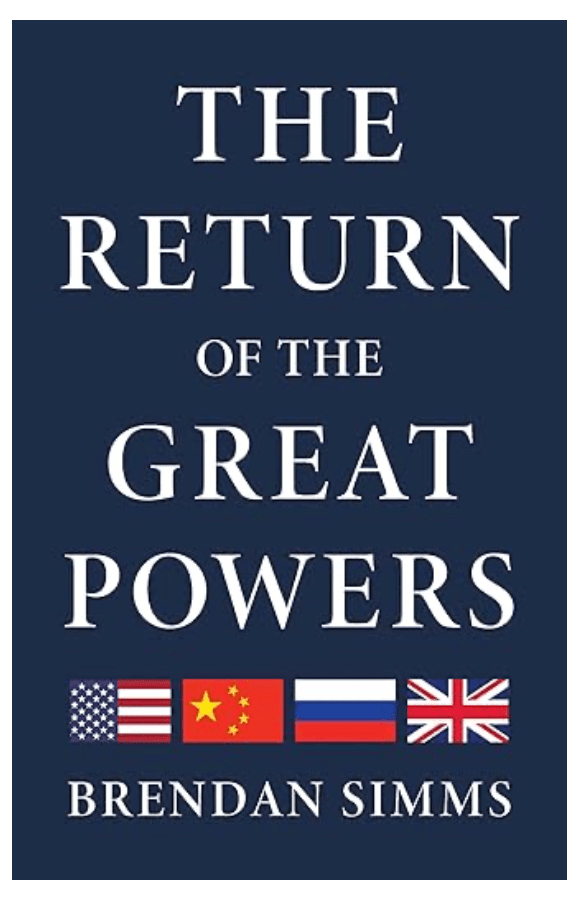
Acclaimed Historian and professor of the history of International realtions at the University of Cambridge, Brendan Simms, brings a sweeping study of the past, present and future of the Great Powers revealing changing new rules of global leadership. From the dawn of the modern era to the end of the Cold War, global history was defined by rivalries between Great Powers. In the West, this meant the struggle for supremacy in Europe and the Americas, while in the East, it encompassed those vying for control over the successor states to Genghis Khan’s empire. Between 1989 and the year 2000, Great Power rivalry temporarily gave way to globalization, with liberal democracy on the march and national chauvinism seemingly in retreat. But events of the past decade have made one thing abundantly clear. The Great Powers are back.
The Return of the Great Powers offers a new history of the rise, fall land return of Great Powers in our time. He shows that over the past ten years or so, the manor global actors have already resumed making decisions based on geopolitical rather than global economic considerations. Simms offers today’s most pressing geopolitical issues, from the Ukraine war to the future of American dominance.
Twenty five years after the cold war, America enjoyed a brief unipolar moment, dominating a system based loosely on rules rather than raw power. That is now all changed. Today’s managed rivalry between US and China, with Russia jostling for advantage, would be familiar to the leaders of the 19th century Europe. With the leaders of Russia and the US launching wars of choice that are turning out to be strategic blunders. Trump’s contempt for America’s allies, his admiration for Putin and his fawning appeals to the Chinese leader Xi Jinping who outmanoeuvred him on Taiwan, are really bad sign for US competence in managing the new competition. According to Simms China, Russia and America will reach advance their own national interest and cooperation to address global problems of climate, disease and regulating AI, is in his view is unlikely.
“Great Powers are the principal axes around which the world turns, they make their presence felt, and their absence creates a vacuum to be filled. A great power do need four crucial qualities like resources – military, economic and human,- does it have reach beyond the country’s own region and a sphere of influence of its own? Is it seen by its own population and by other words does it have the necessary reputation and does it have the resilience to absorb losses and to rebound after defeats ” Simms argues.
Japan and Germany held back by their past and lacking military resources; India, not yet able to project power and a junior player to China in Asia, France, bursting with aspiration but its reach is narrowing and it is too prone to domestic turbulence. Africa and Latin America have regional powers but none qualify as “great”.
Russia does make it, almost entirely on the basis of its military assets, including nuclear. Moscow also has a presumption that it is, and can behave like , a great power. China and the US too, for obvious reasons, even if the Americans are losing enthusiasm for the role. China’s power peaked in 2017-19 and that the outlook for the country and its ruler has since darkened. China has many problems to deal with including its poor demography, its disillusioned youth and its high debt, but they are only few months behind the Americans on technology and are accumulating the military capacity to challenge US supremacy in the western Pacific.
Simms includes the UK among the great powers, while the rest of Europe including the EU, as an organisation fails to make the grade. He underestimates how far Britain’s standing in the world has declined since the hubristic self-harm of Brexit and the political dysfunction that has gripped Britain for the past decade.
The book ends with a warning of the risks of war between the great powers, which Simms says would be catastrophic for the west and probably terminal for Russia and China. He recalls that Germany and Japan in the 1930s felt boxed in by their rivals and shirt of time to achieve their leader’s goals and that is what led them to trigger the second world war. Russia’s position in Ukraine looks more precarious. Trump’s unnecessary war in Iran has changed the international dynamic and further damaged America’s standing. Venezuela has given substance to America slipping back from effortlessly being a global power to consolidating a mere sphere of influence.
The Return of the Great Powers by Brendan Simms, Basic Books £25/$35, 400 pages.

