

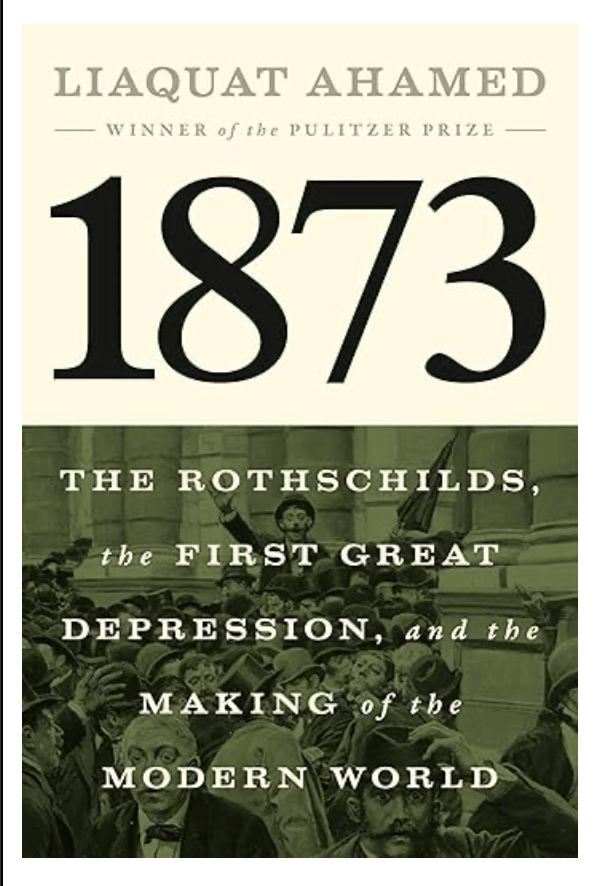
Pulitzer-winning author of Lord of Finance, argues that the boom before bust (the 1873 global crisis has unsettling similarities with today’s AI Frenzy. Over the course of 1850s and 1860s, during the first era of globalization the world experienced an unprecedented economic boom, fuelling the expansion in the global bond market, at the hub of which stood one family- the Rothschilds arguably the wealthiest banking family in history. While the giant gums of capital provided through the bond market built the railroads, the century’s most transformative investments, the money raised also unleashed a frenzy of speculation, massive overinvestment, and wasteful borrowing by governments.
With excessive euphoria leading to disappointed expectations, in early 1870s the bubble burst. Stock markets from Vienna (45%) to New York crashed, and dozens of railroads and many governments defaulted. Financial officials responded by blundering into a precipitous remaking of the global currency system- exacerbating the ensuing economic collapse and setting the stage for decades of a punitive deflation that sparked waves of anti-globalist populism. In 1876, cross-border lending via London had dropped 80 per cent, “Around the world, people were driven by a wide-spread sense of resentment at the injustice of things, and politics took a darker turn” Brilliant financial historian, Liaquat Ahamed. The deeper drama is the euphoric build-up and the toxic aftermath. In 1850s and 1860s, along boom had three causes. First, the absence of global war, although there were many smaller ones. Second, an investment surge in infrastructure: railways mainly, but also canals and subsea cables.
The modernised financial system. Governments issued debt more systematically, often masterminded by the Rothschild banking dynasty. Since the financial system was anchored to bullion, new discoveries of gold expanded its funding capacity. And a burgeoning middle class in the US and Europe began to invest in stocks and bonds.
This resulted in an explosion of financial activity over 25 years, the total market value of financial assets in London, Paris and New York tripled to $60bn. Much of it found its way to the real economy. During this period annual capital investment in western economies rose from 10 per cent of GDP to above 15 per cent, an unprecedented level at that point as transformative projects were financed with securities. America’s coasts were connected when the Central Pacific and Union Pacific railroads were linked in 1869. The Suez Canal was opened six months later. In 1870, Bombay – as it then was- was linked to Calcutta by rail. Vienna’s real estate scene exploded, Berlin hosted 450 initial public offerings in three years. Countries with higher risk profiles could tap the markets. In 1867, the sultan of the Ottoman Empire and the Khedive of Egypt did what might amount to the world’s first high-yield debt roadshow, jointly travelling to London and Paris in part to drum up appetite for their bonds.
According to Ahamed the crash triggered a deflationary struggle as a result of a twist in the 19th century monetary system, which went through “a precipitous and totally unnecessary reordering”. Britain, Portugal, Turkey and Brazil had tied their currencies to gold. The Germans, Austrians, Indians and Chinese were tied to silver. France and the US linked to both metals. The crash took place alongside a pivot by unsettled governments away from silver, mostly towards a more gold-centric system which led to a slump in silver, resulting in a smaller monetary base, contracting the supply of credit and precipitating deflation. Consumer and commodity prices fell, as the value of the debts retained the same. That meant wealth was transferred from borrowers to lenders, reordering the social hierarchy as debt strapped prairie ranchers and business owners struggled to repay their borrowings from lower nominal earnings. In the 1860s the Rothschild Paris operation might host 60 for dinner, with salmon poached in champagne and an appearance by Liszt. By 1866, reliable transatlantic cables made the transmission of information faster, pools of investors were often local, financial companies were more federalised and asset prices less tightly correlated.
Deflation led to commodity rout, crippling Britain’s land-owning aristocrats, over 100 of whom married American heiresses between 1870 and 1944. Ahamed reveals finance and sovereignty and coercion were blurred in ways that seem brutal to modern eyes. After 1870-71 war, France’s repayment schedule of its indemnity to a victorious Germany determined when German troops left France. Near bankrupt Egypt was forced to sell its 44 per cent share of Suez canal, ceding influence. Hard-up Ottoman Turkey resorted to granting tax-collection powers to a European-owned bank, so when the crash came Jewish people were grotesquely blamed. On Wall Street today AI boom is sometimes compared to the 19th century railway bonanza, in which an essential infrastructure was built out by adventurers, geniuses and speculators. Northern Pacific Railway, which faced construction delays, the deferment of revenues led an overexposed bank to collapse.
The modern analogy would be to delay in the schedule of model improvements and data centre to buildouts by Anthropic and Open AI, which involves more equity and less debt than the railway boom, so in theory it is more resilient. However, semi-conductors lasts for less time than sleepers and land. According to Ahamed more than half of American railway bonds were not paying interest by 1879. Today’s world has its own infrastructure frenzy and no longer has guaranteed American leadership, while rich countries have already overdosed on stimulus. Ahamed illuminates new ways of thinking about finance.
He shows us in this enthralling history, the crisis of 1873 was, among other things, a death blow to Reconstruction in the United States and the proximate cause of the Ottoman Empire’s slow death spiral. Ironically, though the Rothschilds had presciently kept a low profile during the bubble, when the deluge came, they were viciously scapegoated as part of a wider hatred directed at “Jewish Finance,” a strain of antisemitism that would come to full evil flower, during the twentieth century.
1873 is bird’s-eye reckoning with the full dimension of the crisis, from its build up to its long aftermath, The Rothschilds and a cast of other witnesses give us the human perspective. Ahamed’s grasp of the larger forces at play, resulting in a global narrative with thrilling explanatory power. Global financial crisis are 1929, 2007-2009, and Ahamed brings the third global cataclysm that was not like either of its successors and raises intriguing parallels with today’s technology and geopolitically charged world.
1873: The Rothschilds, the First Great Depression and the Making of the Modern World by Liaquat Ahamed, Hutchinson Heinemann £25/ Penguin Press $32, 368 pages.

