

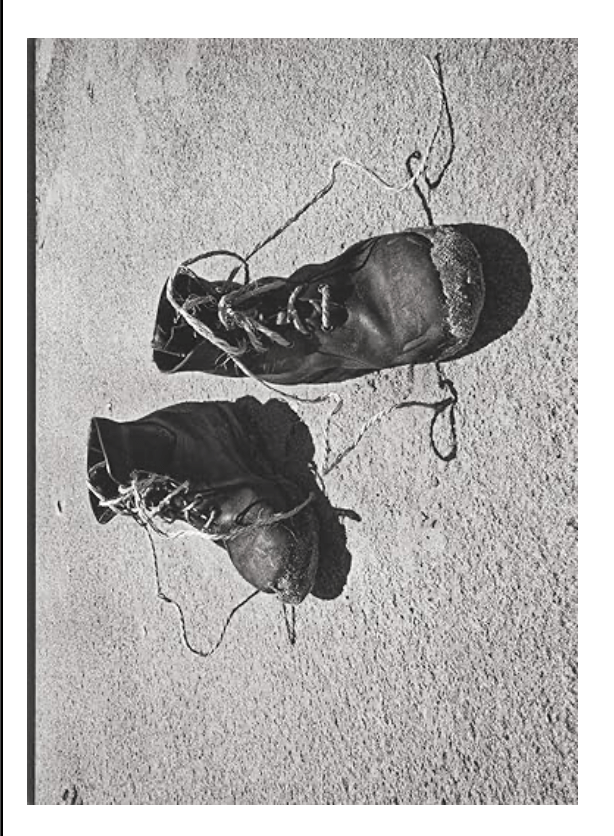
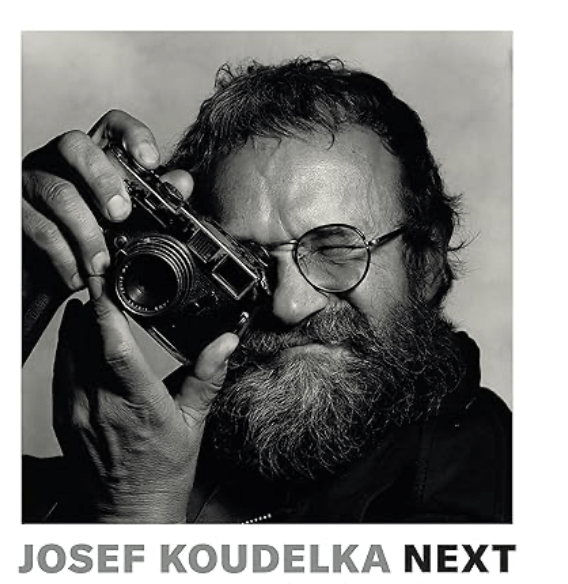
Josef Koudelka, 88, one of the world’s greatest and most revered photographers of the post-war period, who photographer lives on the edge of European society. He came to prominence through his powerful pictures smuggled out of his native Prague after the 1968 Soviet-led invasion, first published in western newspapers anonymously under the attribution P.P. ( “Prague Photographer”). Distilled from sixty-nine journal kept over the course of fifty-plus years, Hosef Koudelka: Diaries offers a peep inside the mind and artistic process of the iconoclastic Czech photographer renowned for a life in exile and legendary projects on the Roma, and the devastating impact humans have on the landscape. Facsimile pages from the diaries, along with images by the photographer, including self-portraits lend the volume an immediacy and authenticity. As curator Tomáš Pospěch writes, “Koudelka’s diaries are a “cookbook” of classic photography. His notes sum up his rich experience, including with the now-vanishing technology of analog black-and-white photography. His remarks, quips, and stories reappear, just as he repeatedly made resolutions, affirmed the rules he had adopted, and recalled earlier events and dreams. “ Diaries is a perfect companion to Josef Koudelka: Next (2023), then visual biography by Melissa Harris.
Koudelka left Czechoslovakia on a plane for Marseille in 1970, to protect his family as much as himself, beginning a long period of exile. His diaries now published by Aperture, begin in 1969. The first entry is the playwright Václav Havel’s phone number. Havel would later become the first president of the Czech Republic. Although man photographers have published memoirs, few have published diaries Koudelka’s written mostly in Czech but also in English and occasionally in French, have been carefully translated by Derek and Marzia Paton, both of whom have worked with Koudelka on other books. Koudelka was unobtrusively photographing the people living in the margins of society.
Koudelka, who kept 69 volumes of manuscript diaries, with battered covers and stuffed with clippings, tickets and other ephemers, set his own standard for social documentation. He travelled extensively, but thought about and looked deeply into the communities he photographed. His work begins at a dark moment of Communist control, with the suppression of the Prague Spring. Later work continued to reveal a political conscience, but it was his photograph taken while living in and travelling across Europe that stand as his most critical work, as he not only recorded what he saw, but also what he felt about what he saw. His first book Gypsis (1975) was preceded and followed by an extended period photographing and living with Roma communities in Czechoslovakia, Hungry, Romania, France, Spain, England and Ireland. He slept outside in a sleeping bag ( his Leica kept inside), eating very simply and often going hungry. He said “ I barfed on their Irish ship and now I am here devouring hedgehogs with gypsies…”. Although his day-to-day needs were basic and did not require much money, analogue photography was expensive and a 1973 entry shows his dilemma: “ So, I have about 1, 000 rolls of 35mm film exposed and I don’t have the money to develop them. What a nice time.” His 1968 images were distributed by the Magnum Photographic agency, and a small income from those would keep him going. So too did an Arts Council Grant of £10, 000 in 1979.
After the fall of Communism, Koudelka was able to return to Prague. But he was critical, writing in 1993: “The Westernization of thinking is taking place here unbelievably quickly: people are losing the opportunity to have time for each other.”
The Diaries also show him in 1980s Beirut, in the midst of the 1990s Balkans conflict, and in Israel and Palestine in the 1990s-2000s ( resulting in his powerful 2013 book Wall). In next book Exiles he conveys with extraordinary power of human conditions of isolation, statelessness and alienations, has been published in three editions (1997-2014), but it is these editions that document the mindset behind such an extraordinary series. “Home is here now, When I leave it will be somewhere else, It is wherever I am. Or rather Home doesn’t exist.”
These diaries expand our understanding of his thought process, showing the practicalities of his often precarioys existence and the inner challenges he faced. In an age where refugees and migrants are often vilified these entries give us an empathetic insight into their plight.
Josef Koudelka: Diaries by Melissa Harris (Editor), Tomáš Pospěch (Compiler), Aleš Najbrt (Designer), Josef Koudelka (Photographer), Translated by Derek and Marcia Paton, Aperture £50/$60, 472 pages

