

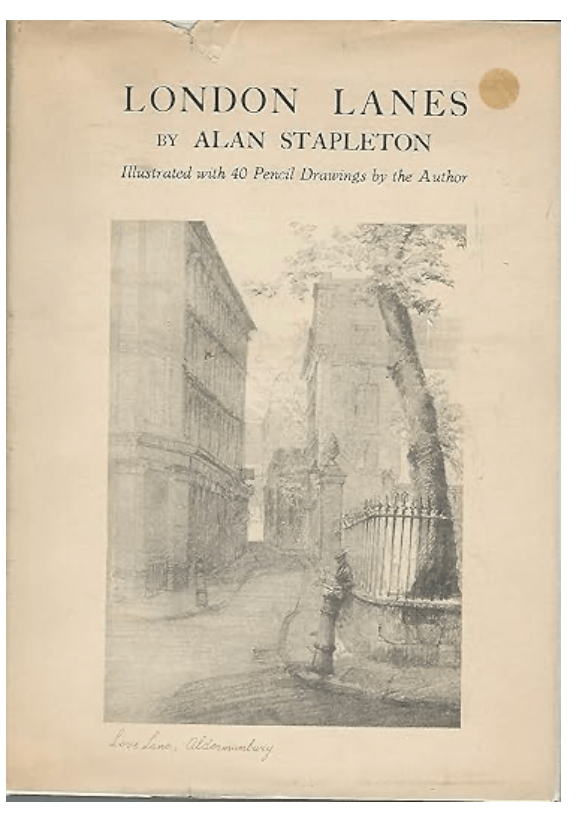
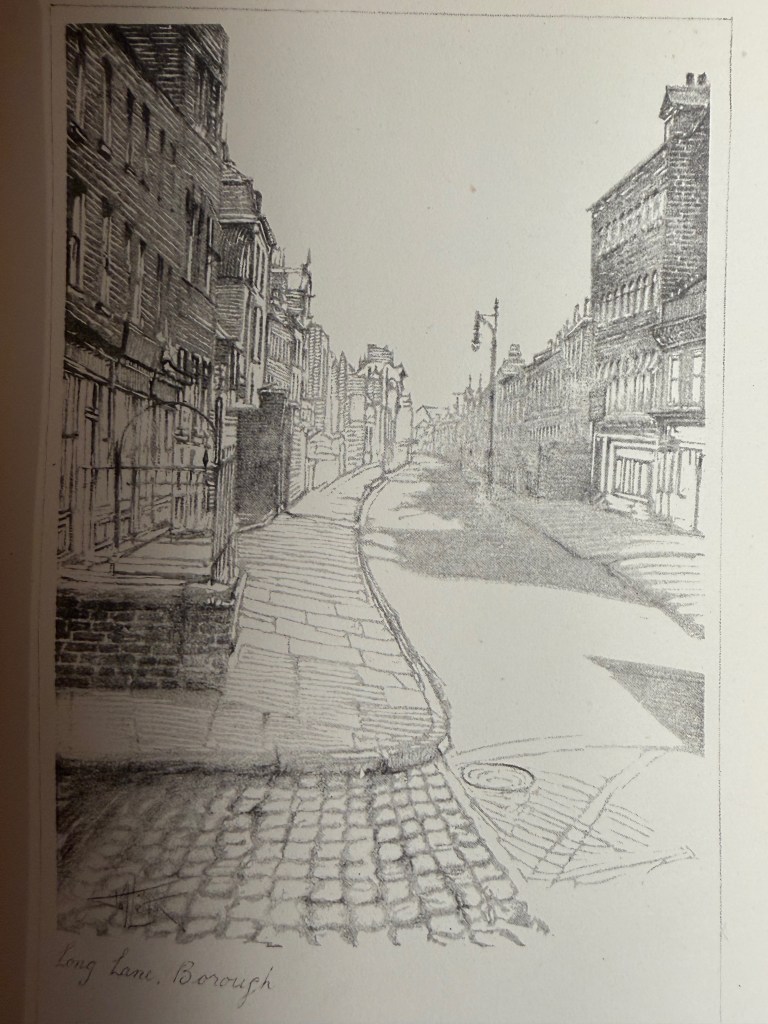
London Lanes is an attempt to enumerate, name and describe, as far as possible, all the lanes old and new of London. Alan Stapleton examines over 900 London Lzness and writes “In the time of Henry VIII and Elizabeth the houses of London certainly climbed skywards along the narrow lanes. These houses were half-timbered buildings of sometimes eight storeys. But each storey bulged out over the next lower, so that the people on the topmost storey could almost shake hands with their neighbours across the way. Up to the end of the eighteenth century the citizens of London lived in the heart of their city- over their business premises, chiefly. This is proved by evidence of old records, documents and maps”.
From the 77 Queen Victoria Street to Upper Thames Street runs Fyefoot Lane, a very slight variation in the spelling from the lane which Stow explained was called Finimore Lane or Fivefoot Lane because it is but five feet breadth at the west end. Five Foot Lane was the old name for Russell Street. Bermondsey, according to a letter from “Ambulator” the Gentleman’s Magazine, 1798, Part II.
Love Lane was the old name for Paris and Little Paris Streets, which skirt Lambeth Palace Garden from the Embankment ( Bishop’s Walk) to opposite Upper Marsh, Froom Stockwell Road to Sydney Street runs yet another Love Lane.
Leather Lane runs nearly parallel with Gray’s Inn Road from 128 Holborn to Clerkenwell Road, The extreme south-western corner only in Farringdon Ward without, the Lane lying in the Borough of Holborn.
Stow says “then higher is Lither Lane” having previously mentioned Gold Lane. He proceeds “turning also to the field, late replenished with houses built.”
Strype mentions: “The East side of this lane is best built, having all brick houses .. In this lane is White Hart Inn, Nag’s Head Inn, and King’s Head Inn – all in-different. “The two latter remain. The lane traverses a very poor neighbourhood, but improved. From the north end it is really picturesque.
London Lanes by Alan Stapleton, John Lane the Bodley Head


This would prove fascinating to any person loving architecture and history and would provide some interestirng walks and days out plus photos and sketches.
LikeLike