

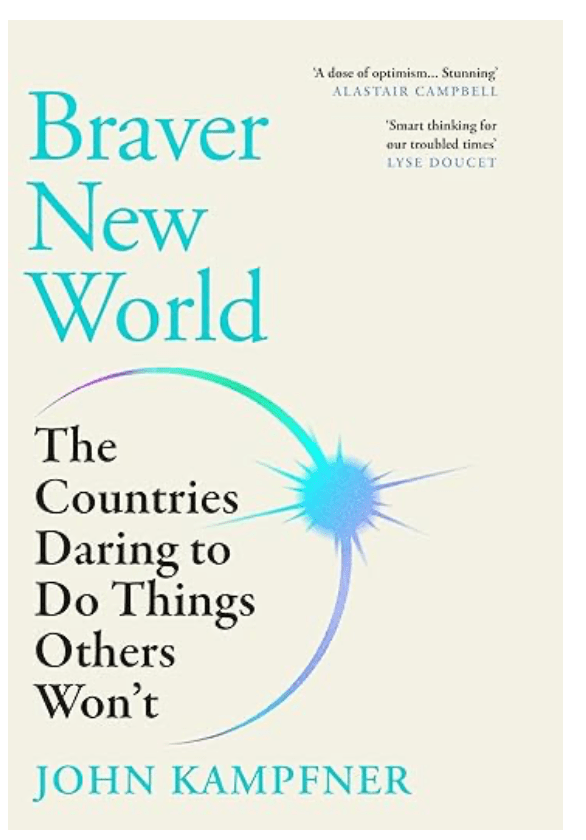
Award-winning journalist, John Kampfner travel to ten countries confronting our shared challenges with bravery and imagination provides a “survival kit” for a world enveloped in gloom. Kampfner’s Braver New World reveals ground breaking exploration of the countries solving the world’s most pressing problems differently and the lessons for the rest of the world. Democracies often gets paralyzed by fear and populations are turning inward.
In Japan, he discovers inter-generational care homes ensuring dignity in later life. He visits Vienna’s century-old housing projects where 60 per cent of resident live in subsidised accommodation without stigma and communities thrive. Taiwan’s health system achieves 90 per cent patient satisfaction at a fraction of the cost of larger economies. From Moroccan solar panels in the Sahara producing enough clean energy to power two million homes to Finnish classrooms preparing children for an uncertain world.
Kampfner introduces us to the people making radical change happen. These aren’t utopias. But what unites them is a refusal to accept that difficult problems are unsolvable. The countries showing true innovation are often those with their backs against the wall- not wealthy nations assuming they have all the answers.
In policy best work often happens through innovation. Welfare states everywhere learnt from Bismarck’s work in Prussia. Although the British pioneered privatisation, and New Zealand the inflation-targeting central bank, America’s founding Fathers learnt from the Dutch when planning a new republic.
Travelling to learn is noble tradition, and on that policymakers from UK are increasingly drawn to, British wanderlust sees their MPs and think-tankers visit Sweden for lessons in education, Germany for their Sparkassen, Canada for its vast, innovative pension funds, and Singapore for everything. In Britain governments were bribing voters with Right to Buy? Canada’s historically humane approach to asylum seekers- treated with decency like the Canadians they may become important assets to the economy. A thousand miles to the south, they would be shoved with performative cruelty into squalid camps. It takes courage to tear up and start anew, to prioritise long-term rewards over short-term plan, and to be frank with voters throughout. To make courage the great misplaced quantity obscures a more complicated story. Take Finland and its fabled schooling, its teachers are brilliantly qualified, not particularly well paid, but held in high social esteem, and for much of the past 20 years generating great results, without much use of homework or the sort of tight monitoring typical elsewhere. Estonia’s rapid digital modernisation was fuelled by the need to drag the country further out of Russia’s clutches, Kampfner writes. Existential risk is a marvellous motivator.
Most politicians are quite brave, on a personal level, to go into politics shows courage to the point of recklessness, but those in charge must be motivated by the right ideals. “Times of Turbulence require radical thinking: they provide the most fertile ground for it too” Kampfner explains.
Braver New World is an urgent reminder that solutions exist. The question is whether we have the courage to learn.
Braver New World: The Countries Daring to Do Things Others Won’t by John Kampfner, Atlantic £22, 400 pages.
 The neptune Herald