

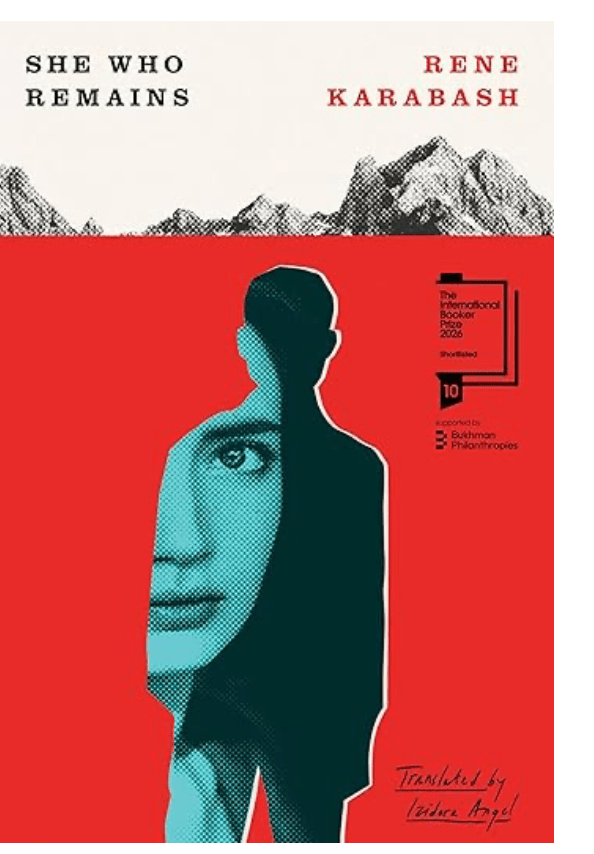
Shortlisted for The International Booker Prize 2026, author Rene Karabash’s She Who Remains, is a landmark Bulgarian queer novel, secrets readers into a rural Albanian village where to this day, the Kanun of Leké dukagjini- a collection of Archaic laws- looms over the lives of villagers with the same haunting presence to the surrounding mountains.
Bekija, painfully aware of why she cannot have what she most wants, chooses to become a “sworn virgin, setting off a bloody and heart-breaking chain of events that shatters a family and destroys a cherished relationship, but also reveals how trauma can lead to vital, if uncomfortable, truths. Karabash’ poetic stream of consciousness traces gender evolution with innovative grace.
The bold exploration of what it means to be a woman in a world defined by the violence of ancient patriarchal traditions has resonated with readers across Europe and beyond, and now English language readers won’t soon forget Izidora Angel’s award-winning translation.
A woman takes oath to escape an arranged marriage. Karabash born Irena Ivanova is also a poet, screen writer and playwright and these skills are quite evident in a work that defies neat classification.
Bekija whose name means “she who survives, she who remains alive, she who saves herself”, lost her twin brother in her mother’s womb. Aware that her father had wished his son had survived instead –mothers here get pregnant in the hope of bearing boys so they don’t bring shame to the family” – she has spent her childhood taking on men’s work, and striving to become a “daddy’s boy”. Bordering eastern Montenegro and western Kosovo, the region is governed by the ancient laws of the Kanun, which permeate all aspects of family life, from marriage to property. “ A Lot of men die hwere because of those blood feuds, the blood tax, everything revolves around the Kanun,” Bekija tells a journalist who interviews her 16 years later about becoming a sworn virgin.
Bekija aged 18 when her father claims she is of “of marrying age”, refuses a forced marriage to Nemanja, a local ugly man “ from a good family”. She asks herself “ Am I getting married or getting buried?” and renouncing her womanhood.
Her broken marriage contract provokes a blood feud, and she is faced with choosing a male member of her own family to be killed so that Nemanja can “reclaim his honour”. She gives the nominated black armband to her young brother Sále, who flees to Bulgaria, leaving her father, Murash, as Nemanja’s target. With her family destroyed, Bekija becomes Matija, living alone and dressing as a man. She uncovers unread letters from Sále, revealing past lies and her forbidden love for Dhana, the great granddaughter of a neighbour who spent summers in the village.
Karabash circles around incidents, her vivid imagery and recurring motifs lending the narrative a fairy tale quality while exposing the reality for women in this harsh world, where they are repeatedly dehumanised, treated or sold like livestock. Women at a funeral are described as “Black head scarves like a swarm of ants”, while the unmasculine Sále is derided as gevsek (weakling). Dreams and fragments of poetry are interwoven through the story adding to its hallucinatory, shifting sense of reality.
She Who Remains by Rene Karabash, Translated by Izidora Angel, Peirene Press £12.99/ Sandorf Passage $18.95, 160 pages.
 The neptune Herald