

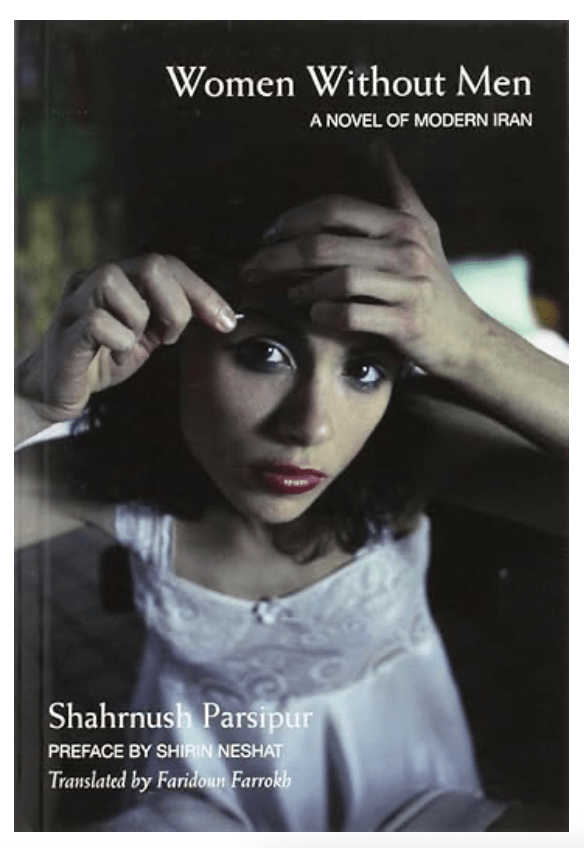
Women Without Men, by Shahrnush Parsipur, now 80, we follow the lives of five women against the background of revolution and coups as they find their way to a garden, drawing on recent Iranian history and transcendent elements of Islamic mysticism, Parsipur’s unforgettable novel sees women escaping strict confines of family and society. Five repressed women abandoned or humiliated by men, discover new, sometimes surreal paths for themselves. As societal expectations and the fear of spinsterhood weigh on, Iran tried and failed to silence Women Without Men ( Zanan bedun-e Mardan in Persian) exposed the brutality of Iranian regime and creates an evocative and powerfully drawn allegory of life in contemporary Iran. Five women including a wealthy middle-aged housewife, a prostitute and a schoolteacher – as they arrive by different paths to live together in an abundant garden on the outskirts of Tehran.
Banned shortly after publication for its depiction of female freedom, Women Without Men, Parispur continues her protest against traditional Persian gender relations in this modern literary masterpiece.
Parispur endured several periods of imprisonment in Iran including in 1976 for protesting against the Shah of Iran’s secret police, and in 1981 after the Islamic Revolution. Following the publication of Women Without Men, in 1990, she was detained for its references to virginity. She eventually fled into self-imposed exile in the US. Banned in her own country, the novella continued to circulate underground.
The oppression of women is an incendiary subject in Iran.
Societal expectations and the fear of spinsterhood weigh on Mahdokht, a former school teacher, While staying at her brother’s villa in Karadj, in the foothills of Alborz mountains, she is horrified to discover the gardner and a 15-year-old maid having sex. Her vision of the maid’s fate if she returned home in disgrace – “The brothers would have ganged up on her and beaten her to death”. Mahsa Amini, the young Kurdish-Iranian woman whose death in 2022 in the custody of the morality police, after her arrest in relation to the country’s Islamic dress code, ignited nationwide protests and the slogan “Woman, Life, Freedom”.
Mahdokht’s brother sells his villa to Mrs Farrokhlaqa, a woman with ambitions to become someone of influence. After 32 years of marriage she frees herself from a man who mocks her age and menopause by literally pushing back and inadvertently sending him tumbling down the stairs. In her new home she finds that Mahdokht, a stranger to her, has transformed into a tree, rooting herself in the soil: “She was buried in the ground up to her knees, wearing a tattered dress, standing erect.” It’s an act of resistance she can spread her seeds freely without male intervention.
Twenty-eight-year-old Fa’iza is determined to marry Amir Khan a “Squarely built man pushing forty”. She regularly visits his sister Munis, hoping he’ll propose only for Amir to choose an 18-year-old “caring dutiful” virgin instead. He believes “women belong in the house. The outside is the world of men.”
When Munis takes her own life, she returns from the dead only for Amir to stab her for having ruined the family reputation. Munis resurrects herself again. She travels with Fa’iza to Karadj, where they are invited to stay in Farrokhalqa’s garden villa. They are joined by Zarrinkolah, a prostitute who leaves her brothel when her customers appear to her headless.
Women Without Men by Shahrnush Persipur, The Feminist Press at CUNY Translated by Faridoun Farrokh, Penguin Classics £12.99, 136 pages.


C,learly this book exposes much about the plight of women in modern Iranian society and highlights the complete difference between their regime in contrast with modern “western” society. It seems the lady who penned the book is in another country now afraid for her life after her exposing writings and accounts. This account would probably make an interesting film though I am thinking that if a film WERE made, it would cause more demonstrations and reactions than ever and would it be worth it? All women must take care not to get demonised by men and all men must learn to be gentle understanding tolerant and fair. Peace. Aymen,
LikeLike