

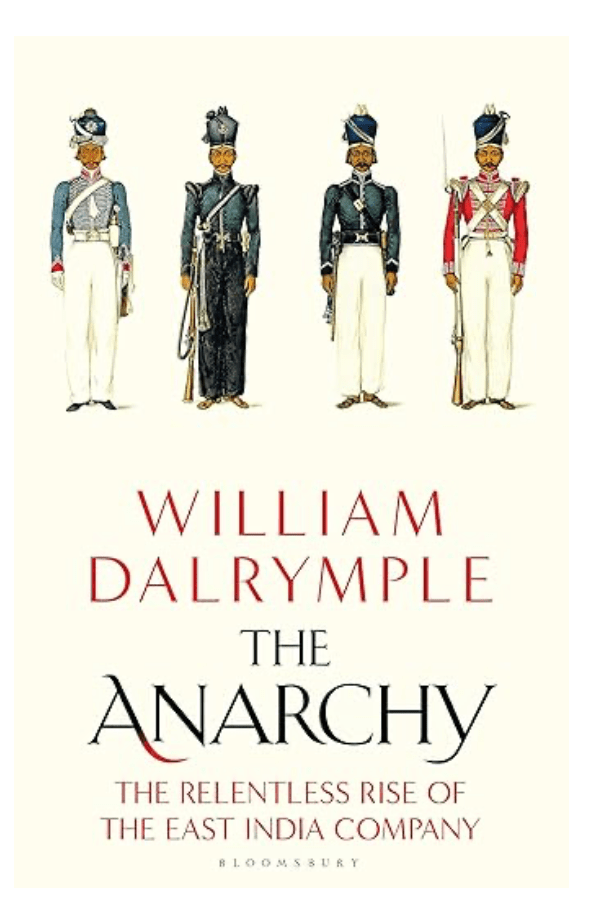
Historian Dalrymple whose visceral understanding of India, in Anarchy tells the remarkable story of how one of the world’s most magnificent empires disintegrated and came to be replaced by a dangerously unregulated private company, based thousands of miles overseas in one small office, five windows wide, and answerable only to its distant shareholders. This relentless rise of in August 1765, the East India Company, who defeated the young Mughal emperor and forced him to establish in his richest provinces a new administration run by English merchants who collected taxes through means of a ruthless private army- what we would now call an act of involuntary privatisation.
The East India Company’s founding charter authorised it to “wage war” and it had always used violence to gain its ends. The creation of the new government marked the moment that the East India Company ceased to be a conventional international trading corporation dealing in silks and spices and became something much more unusual: an aggressive colonial power in the guise of a multinational business. In less than four decades it had trained up a security force of around 200, 000 men – twice the size of the British army- and had subdued an entire subcontinent conquering first Bengal and finally, in 1803, the Mughal capital of Delhi itself. The company’s reach stretched until almost all of India south of the Himalayas was effectively ruled from boardroom in London.
The Anarchy tells the story of the East India Company as it has never been told before, unfolding a timely cautionary tale of the first global corporate power.
A series of giant murals was unveiled in the Palace of Westminster depicting the “Building of Britain”, which bounded in eight set-pieces from King Alfred’s long-ships beating back the Danes in 877 to bewigged Parliamentarians presenting Queen Anne with the article of Union in 1707. The scene travels to India in 1614, where the Mughal emperor Jahangir receives an ambassador from King James 1, on a mission to promote trade with the newly chartered English East India Company.
According to Dalrymple, “Robert Clive of India”, 1st Baron Clive 1725-1774, an East India Company accountant who rose through his remarkable military talents to be Governor of Bengal. Thickset, laconic, but fiercely ambitious and unusually forceful, he proved to be a violent and ruthless but extremely capable leader of the Company and its military forces in India. He had streetfighter’s eye for sizing up an opponent, a talent at seizing opportunities presented by happenchance, a willingness to take great risks and a breath-taking, aggressive audacity. It was he who established the political and military supremacy of the East India Company in Bengal, Bihar and Orissa and laid the foundation for British rule in India.”
Leo Tolstoy’s letter to a Hindu, 14, December 1908 said “A commercial company enslaved a nation comprising two hundred million people”.
Edward, First Baron Thurlow (1731-1806), the Lord Chancellor during the impeachment of Warren Hastings said “Corporations have neither bodies to be punished nor souls to be condemned, they therefore do as they like.”
Amid the anarchy of Mughal decline, Aliverdi Khan, Nawab of Bengal, (1671-1756), who was of mixed Arab and Afshar Turkman stock, came to power in 1740 in Bengal, the richest province of the Mughal Empire, in a military coup financed and masterminded by the immensely, powerful Jagat Seth Bankers. After defeating the Marathas, he created in Murshidabad a strong and dazzling Shia court culture, and stable political and economic centre.
Shah Alam, a talented Mughal prince whose life was dogged by defeat and bad luck, but whose determination through horrific trials, including as a boy he had been Nadir Shah ride into Delhi and loot it. He later escaped Imad ul-Mulk’s attempt to assassinate him and repeated battles with Clive. He fought the East India Company at Patna and Buxar, awarded the Diwani to Clive at Allahabad and by his cross-country trek back to Delhi. With Mirza Najaf Khan, against all odds he nearly succeeded in rebuilding the empire of his ancestors, only to see it vanish like a mirage after the premature death of that last great Mughal general. The Emperor was assaulted and blinded by his psychotic former favourite, Ghulam Qadir. After the rape of his family and his blinding by the Rohillas- he allowed himself to
give way to despair. He ruled over a court of high culture, and as well as writing fine. Verse himself, he was a generous patron to poets, scholars and artists.
Dalrymple draws on reams of scarcely used documents in Persian, Urdu and other languages to animate characters such as the brilliant Mughal general Najaf Khan, the vengeful Rohilla prince Ghulam Quadir, and the Maratha statesman Mahadji Scindia. He sets a scene as well as he does, scoping out an enemy fleet through an informant’s spyglass, or watching the waterlogged bodies of famine victims floating down the Hooghly river, or ruined streets of ransacked Delhi. As constitutional norms under threat in both countries, the defences seem more fragile than ever.
The Anarchy: The Relentless Rise of the East India Company by William Dalrymple, Bloomsbury, £30, 576 pages
 The neptune Herald
Indian history makes a very good read and many people do not know much about the Mughal empire in India – especially Europeans – OR the crossover with the Persian people. There is ample opportunity to film and televise the story though it would probably be expensive. The glamour, opulence and sheer high intellience, hard work and hard diligence of these historical times are awe inspiring. India has always ranked in the world for its genius, artfulness, romance, skills and craft as well as its politics and of course films and food! Perhaps its time that all of us in the UK and in other countries start appreciating this even more than ever!
LikeLike